















Photography by Tom Pilston

9 min read2 hr
With Northern Ireland haunted by the violence of its recent past, Chris Bryant tells Francis Elliott he is determined to help victims’ families – including those of murdered soldiers and police – to find comfort
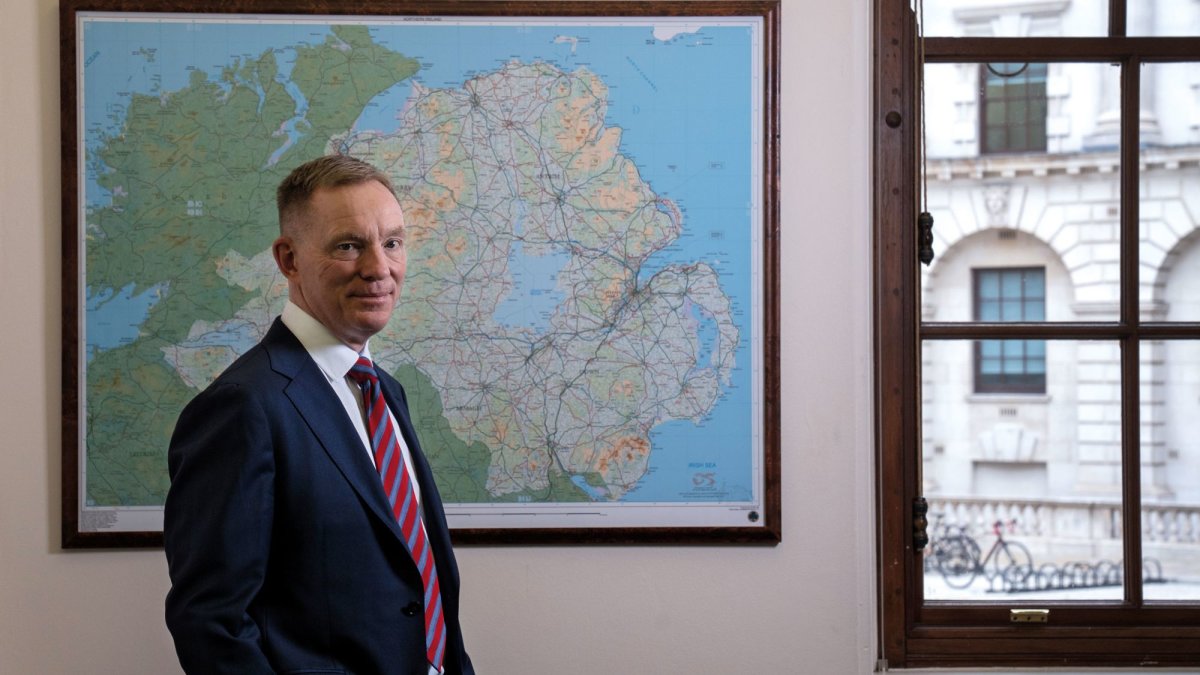
Chris Bryant was as surprised as everyone else when Andy Burnham asked him to replace Hilary Benn as Northern Ireland Secretary. He did, however, have an idea of the new Prime Minister’s reasoning.
“Somebody said: ‘Why on earth have they appointed you?’ and I said: ‘Maybe Andy wants somebody to break some eggs.’ But what I’ve decided is that if I am going to break eggs, I prefer to make meringues than scrambled eggs.”
The 64-year-old Rhondda and Ogmore MP and former Church of England cleric has had a baptism of fire as tensions flare over a proposed Orange Order march in Drumcree, a worsening budget crisis and in the wake of Donald Trump’s declaration that a united Ireland would be “fantastic”.
As if that wasn’t enough, Bryant has now revived Labour’s manifesto commitment on dealing with the legacy of Northern Ireland’s Troubles in which more than 3,500 were killed. Although the vast bulk of deaths were at the hands of paramilitaries, some were killed by British soldiers, including in notorious events like Bloody Sunday.
The previous Conservative government’s 2023 Legacy Act banned inquests and civil actions arising from the conflict amid anger that elderly veterans were being subject to ‘lawfare’. Its most controversial element – immunity in exchange for information – was found to be unlawful. Many also believed it implied a moral equivalence between the actions of paramilitaries and soldiers that caused deep offence.
Labour’s alternative approach, built around a joint agreement with the Irish government, is for a Legacy Commission that will investigate Troubles killings, a separate information recovery body and a dedicated legacy unit within An Garda Síochána (Ireland’s police force). Crucially, however, it allows for the resumption of some suspended inquests as well as potential future prosecutions. For the Conservatives and some veterans leaders, that is unacceptable. Former defence minister Al Carns is opposed. A battle in the House of Lords seems certain.
Bryant implicitly acknowledges that the incoming Labour government mishandled the backlash when the legislation was first introduced two years ago. “People got a bit spooked by some of the opposition to some of the issues that we hadn’t got right in the original draft,” he says. In other words, Sir Keir Starmer took fright and ordered Benn to put the issue on the backburner.
Burnham evidently thought that a new approach and a new Northern Ireland Secretary were needed to get the legislation back on track. Bryant and Wes Streeting, the new Defence Secretary, met within weeks of taking up their new roles to retool the legislation, adding in more protections for veterans, including a demand they are represented on the commission’s advisory board and that the Attorney General must personally sign off new prosecutions.
More than 150 amendments were laid by the government which has set a deadline of April next year to pass the bill.
But, just as importantly, Bryant wants to reframe the debate. He is determined to challenge a narrative that sets veterans in opposition to victims’ families. His main point is that by far the biggest group are in fact the families of veterans who were killed in the conflict.
Among those Bryant invited to the gallery earlier this month to watch the Northern Ireland Troubles Bill carry-over extension was Mo Norton, whose brother Terence Griffin was among those killed by an IRA bomb on a coach to Catterick in 1974 on the M62. In Bryant’s telling, it was people like her who were left owing when the Troubles were brought to an end in 1998 with the signing of the Good Friday Agreement (GFA), also known as the Belfast Agreement.
“The people who bore [the cost] weren’t the senior politicians; it was the families. You only have to sit down with some of these families for 10 minutes and you are in tears,” he says. “If we could get an answer to the who, why, and how of the Guildford pub bombing and the M62 bombing, quite a lot of families would be provided with a measure of release and comfort.”
For victims’ families in Northern Ireland, the truth can be all too painfully apparent – even if unacknowledged. “I met one man whose father served and was murdered, and he meets the man who he knows murdered his father every single week in Marks and Spencer,” Bryant told the Commons. “It has not even been acknowledged in any tribunal of any kind.”
Many of the answers to questions that would allow a measure of closure lie across the border in the Republic. He is robust about the need for Dublin’s government to “step up” efforts to show that it is as committed as the UK to the new effort to deal with the legacy. He also wants them to contribute more to the cost of the new bodies.
“I’ve heard a lot from people who are profoundly sceptical about the Irish government, and I get that. If you’re somebody whose uncle was murdered by somebody who popped across the border, murdered them, and then went back… and nobody ended up being extradited or facing justice or whatever, I can understand why people feel very angry and concerned about that.
“You only have to sit down with some of these families for 10 minutes and you are in tears”
“Obviously, the Omagh inquiry [into the 1998 Real IRA bombing] is happening at the moment, and I think the lead counsel has been a bit critical of the Irish government’s co-operation. I raised that with my counterpart this morning and he’s going to make sure there is the co-operation.
“The relationship between the government in Dublin and myself, I would say, is very strong and between the governments is very strong, and we are able to say to each other when we need to step up.”
Bryant also raised the subject of gelignite, he says. He acknowledges that the facts around the IRA’s use of the explosive are still unknown, but the issue is that “a lot of the gelignite that was used seemed to have stemmed from one quarry in the Republic”.
“Did people know about it, what documentary evidence is there?” Answering such questions can only help, he says. “We have a good trusting relationship, but I think the more the Dublin government can show they are fully up for finding out what really happened across the whole Island the better.”
He says the Irish government has promised to legislate to mandate the new Garda unit to start its work on a timetable that will see simultaneous implementation on both sides of the border as soon as the bill receives Royal Assent.
On the wider issues around the Northern Ireland Executive, a border poll and of course Drumcree, Bryant is as direct. He dismisses calls from the Taoiseach, Micheál Martin, for a discussion to “tease out” the circumstances that could trigger a unification referendum.
Bryant insists that the wording of the GFA that leaves the decision solely in the hands of the Northern Ireland Secretary is not a topic for discussion.
And when it comes to the one demand that unites the parties in Northern Ireland – more money – the Rhondda MP is not for turning.
“There is no more money to be had anywhere,” he says, calling on the Executive to live within its means as other devolved administrations must. “There’s no more money at the back of the sofa. There aren’t any more sofas to look down the back of.”
He has called Sinn Féin and the Democratic Unionist Party irresponsible for failing to agree a budget and is unmoved by warnings of a looming crisis in Northern Ireland’s public services in the new year.
Warnings of the fragility of the institutions are overblown, he suggests, as shown by the aftermath of events around the Drumcree march – first allowed, then not allowed and now the subject of a judicial review.
“The Executive has proved remarkably resilient. Everybody said this would mean the end of the Executive in a couple of days, and it hasn’t so far.” For all the blood and thunder rhetoric, “people have gone to their lawyers, not their gun cabinets”.
It frustrates him, he says, that the row obscures a much more positive story about Northern Ireland as the fastest-growing part of the UK, thanks in no small part to its privileged access to both the UK and EU markets.
In his latest book, A Life and a Half – an unusual, moving and in places highly entertaining, memoir – Bryant concludes that while “emotionally robust”, “rage still sometimes descends on me”. Is he, one wonders, in the right job?
He contends that his patience in dealing with the seemingly endless and intractable debates in Northern Ireland has surprised him. His resilience is proven – he still requires regular ‘cancer admin’ but it does not trouble him overmuch, he says. He has lost sleep over some difficult decisions but is clearly delighted at making the Cabinet and gives every impression of enjoying it. Bryant has always had a certain cussedness and perhaps Burnham concluded that Northern Ireland’s politics had grown rather too comfortable in its dysfunction.
Certainly, Bryant believes its politicians have become “addicted to the abnormal” and need a spell of “cold turkey” – starting with having to deal with the realities of making difficult decisions about resource allocation.
He also wants improvements to fiscal and ministerial responsibility, as well as standards oversight to be agreed before the next election in May. Although he says he is not interested in “the game of chicken”, he doesn’t mind flashing a little menace in the form of a return of direct rule should the Executive collapse.
“Someone said, ‘Why on earth would you want Chris Bryant to run Northern Ireland?’ And they’ve got a point. Why on earth would Sinn Féin want Chris Bryant to run Northern Ireland? It’s irritating – they keep on calling me English, I think they’ve worked out I’m Welsh now. But honestly, why? So, there’s a very strong argument internally to them for wanting to keep the show on the road.”