
















Photography by Louise Haywood-Schiefer

11 min read1 hr
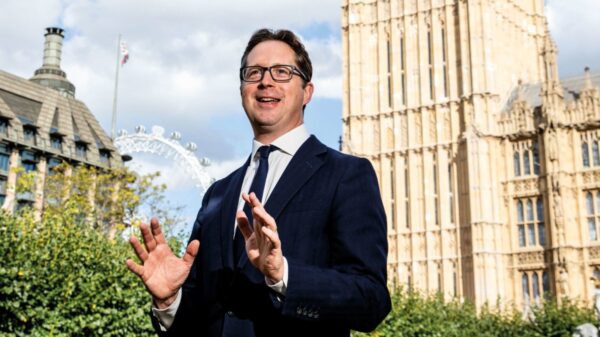
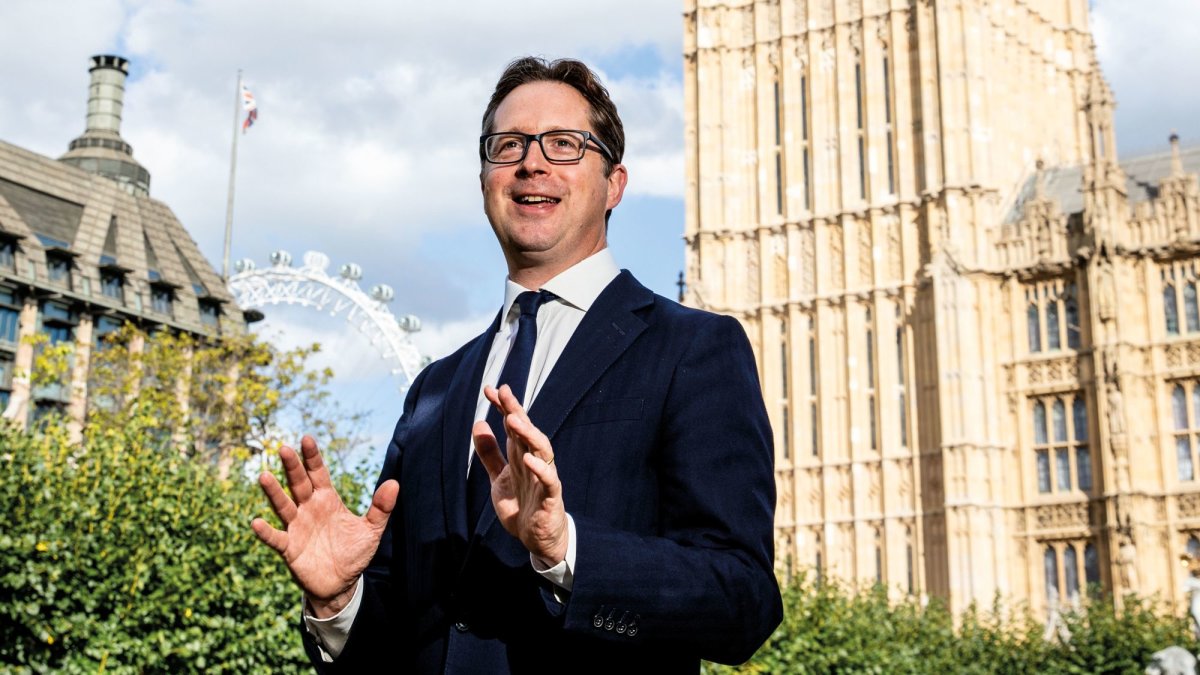
Conservative deputy leader Alex Burghart speaks to Noah Vickers about his friendship with Kemi Badenoch, whether his party is still a broad church, and the need for change in Northern Ireland.
The Conservative Party has a new deputy leader and his name is Alex Burghart. The 49-year-old MP for Brentwood and Ongar may not enjoy the highest of public profiles, but he has long been a core member of party leader Kemi Badenoch’s inner circle.
The position of deputy leader has been technically vacant for more than two decades – having last been held by the late Michael Ancram in 2005.
“I think it means more work and the same pay,” quips Burghart, who has added the title to his existing roles as shadow chancellor of the Duchy of Lancaster and shadow Northern Ireland secretary.
“I’ve been a longtime ally and supporter of Kemi’s and I was very pleasantly surprised when she said to me during the reshuffle, ‘I could do with some help at the centre, and I’d like you to come and help me kick the tyres on a few things,’ so that’s what I now do.”
Burghart’s first run for Parliament, in 2015, saw him go up “against a little-known left-winger called Jeremy something” in Islington North.
“That’s where I won my spurs. I went round Islington North standing up for conservative principles and free-market economics and so on.
“At that election, I made the strategic decision to lose by 20,000 votes, and then within a few weeks Jeremy became leader of the Labour party. His career took off rather faster than mine.”
Burghart had to wait until the snap election of 2017 to win his Essex seat – the same intake as Badenoch and representing constituencies which border one another. Since Badenoch’s election as leader, commentators have called Burghart a “key confidant” or even her “policy brain”, though he rejects that label: “Kemi’s got her own policy brain. She’s got plenty of brains herself.”
He accepts, however, that he performs an important role as someone who can speak openly and honestly with her in private.
“Because we’re close and we trust each other, I can speak to her very frankly and she can speak to me very frankly.
“Ultimately, that’s what all good operations need – and she is a very inspiring person to work for, because she always has a very strong sense of right and wrong and the direction the party should be going in. My job is sometimes to kick the tyres on that and sometimes to make it happen.”
And telling her when she’s made a mistake?
“I tell her when I disagree with her. She’s normally right,” he laughs.
Leading the opposition is said to be the worst job in British politics, but Burghart claims Badenoch is “loving” it and is “thriving” in the role.
“It’s incredibly hard being leader of the opposition and being leader of the opposition after a historic defeat is uniquely challenging,” he acknowledges. “When you look at what she’s managed to do over the course of the past year, it’s extremely impressive.”
Burghart’s pre-political background is in medieval history, having taught and lectured in it after completing his PhD on the Anglo-Saxon kingdom of Mercia. He is fascinated by how Mercia existed between the “catastrophic” fall of the Roman Empire and the birth of England as we know it today.
Post-Roman Britain, he points out, had seen “an extraordinary collapse in civilisation, which is probably more profound here than at any other point in Roman Europe”.
Yet from out of the Dark Ages, there came – eventually – a new and longer-lasting order.
“Within a few hundred years emerges the most stable medieval polity, which is England, which is still around today – which is still using [the same] boundaries of local government, the same currency, the same monarchy, and ultimately the same basic system of law. Out of the great collapse emerged something even more durable than the Roman Empire.”
For a Conservative Party still recovering from its worst ever general election result, could there be an analogy here?
Burghart allows the point with a laugh. “Sometimes you have to go through the bad times to get to the good.”
There are certainly more reasons for the Conservatives to be cheerful than there were 12 months ago, as Reform UK has seen its poll ratings slump. Burghart doubts, however, that traditional two-party politics will re-assert itself any time soon.
“We’re certainly in multi-party politics for the time being and my suspicion is that that isn’t going to settle down just yet,” he says. “I think one of the reasons why the system has become more populous is because of the rise of new types of media, which allow people to organise and sit within their own channels and I don’t think that’s going to change.
“But at the same time, that doesn’t mean that the same spread of voting needs to persist. If you look at how the Green vote has shifted up and down quite dramatically – and indeed Reform’s vote has shifted up and down quite dramatically – what it speaks to is a period of high volatility. In that environment, there are opportunities for a party that is firm of purpose and principle.”
When The House speaks to Burghart, his party is facing attacks from Reform’s Robert Jenrick over reports that the Conservatives are preparing to announce a plan to abolish inheritance tax.
Jenrick claims the Tories are “choosing to help the wealthiest five per cent, while we want to raise the tax-free personal allowance to £15,000 to benefit 97 per cent of workers instead”. Is he right?
“As we don’t leave our speeches on photocopiers, Robert doesn’t know what’s in Kemi’s speech at conference and he’ll have to wait until the start of October to find out.
“If Reform want to talk about the Conservatives being a tax-cutting party, they can do so, that’s up to them.”
He smiles and adds: “But I’m not sure how much longer Reform will want to talk about money.”
There is clearly no love lost between the Tories and the MPs who have defected away from them. If any of those MPs were one day to regret their move, would they ever be welcome back in the Conservative fold?
“I think if you start to entertain the idea that people can just come back, what you’re signalling to colleagues 10 or 20 years down the line is that you can just experiment with changing parties and everything will be fine – and it’s not fine.”
Pressed on whether that means the door is closed to them, he replies: “I don’t see any circumstances in which anyone’s coming back.”
As The House starts asking a new question, however, Burghart interrupts with a final caveat: “But I should say, it’s up to Kemi.”
Indeed, the Conservatives are already in the process of selecting candidates for the next election. Liz Truss, according to Badenoch, is among those not welcome to stand.
“I’m not sure how much longer Reform will want to talk about money”
But she has also said that candidates who support policies like net-zero by 2050 or staying in the European Convention on Human Rights (ECHR) will be blocked too. To what extent is Badenoch remaking the party in her own image?
“I think it’s very important that the Conservative Party looks fresh at the next election,” replies Burghart.
“Kemi was keen to build a shadow cabinet which was new, so she is obviously very mindful that, as a basic rule, people who become candidates for the Conservative Party should be on side with the changes that we’re planning, because otherwise it’s harder for us to promise the electorate that we will deliver on them. If you’re looking for ways to prove that you’re serious, this is one of them.”
Asked whether the party is still a broad church where ‘One Nation’ conservatives are welcome, he suggests that may depend on what is meant by ‘One Nation’, as the term can be “ill-defined”.
“If we’re talking about Disraeli and One Nation conservatism, regardless of what badge colleagues may or may not choose to apply to themselves, Disraeli never uses the phrase.
“He says there are two nations – there’s the rich and the poor – and implies that government should govern for everyone. That’s what a future Conservative government will do.
“But running through that are the values that support our work, which is that we’re there for families and people who do the right thing, people who work hard. That’s the sort of country and society we’ll always stand for.”
The House turns to Burghart’s Northern Ireland brief, asking what he made of Donald Trump’s recent claim that a united Ireland would be “fantastic”.
“Well he’s wrong, and it’s not for him to say,” the MP declares, adding: “The President likes to stir things up.”
Is that what Burghart thinks Trump was doing with that comment?
“I do, but I also wouldn’t read too much into it.”

If the Tories win the next election, Burghart will be tasked with ensuring the UK’s exit from the ECHR does not imperil peace in Northern Ireland, as concerns have been raised about whether the move would be compatible with the Belfast/Good Friday Agreement.
The agreement’s wording is explicit that “the British government will complete incorporation into Northern Ireland law of the ECHR, with direct access to the courts, and remedies for breach of the convention”.
Burghart says he is satisfied by Lord Wolfson’s legal advice for the Conservatives on this question, which argues that the “substantive rights embodied in the text of ECHR” could be applied to Northern Ireland through a separate legal framework.
The Irish government may require some convincing of this, The House suggests, as the Tánaiste, Simon Harris, has warned the ECHR is a “fundamental safeguard” and a “core part” of the agreement.
“As a sovereign country, we are entitled to leave the ECHR if we wish to,” Burghart insists.
“There are certain provisions that we would need to make in order to take account of the Belfast Agreement, but that does not prevent us from leaving.”
The Northern Irish Assembly, which operates through an often-paralysed power-sharing arrangement, is meanwhile in one of its states of deadlock – having still not passed its budget more than five months into the current financial year.
As his Labour counterpart Chris Bryant warns it is “time to stop accommodating madness and find a better way of working”, Burghart is clear that he, too, would be open to making reforms to Stormont.
“I’m not going to pretend that the arrangement is as good as it should be,” he says. “That said, it’s very difficult to shift those things without cross-community consent.
“But I think [we are in] a situation in which it is very clear that certain big decisions do not get made, repeatedly, and public services for people in Northern Ireland are worse as a result… At some point, everyone is going to have to acknowledge that this isn’t good enough and we will need to find an alternative.
“It wouldn’t be appropriate for a secretary of state or a shadow secretary of state of Northern Ireland to say, ‘It’s got to change and this is how it must be’. But I think we should certainly be open to reforming the institutions. Equally, I’m not going to pretend that is an easy process.”
In the last government, Burghart served as a Cabinet Office minister, where he was responsible for setting up Whitehall’s first dedicated AI unit.
With recent reports of AI agents going rogue and experts warning of a potential threat to human life, he admits that “the sheer distance that the technology has travelled” is “bewildering”. Does it worry him?
“Yes, but I’m a middle-aged man, I worry about a lot of things.”
More seriously, he adds: “I think everyone who has looked at this – who is honest with themselves – is a bit worried about it, because we simply don’t know where it’s going to end.
“It may be that the technology hits a wall quite soon and we learn to live with it as it is, but there’s no sign of that slowing down.”
He is sceptical about whether there is any meaningful action the UK government could unilaterally take to contain the risk.
“It’s an area where it’s extremely important to have ongoing dialogue between the people who are building the capability, and government and regulators. However, for a country like the UK to think that, alone, we can just regulate our AI and make it safe, I think is crazy. There is no one country that will be able to do it.
The work that Rishi Sunak tried to do was to “make sure there were fora in which people from around the world could raise concerns”, he says. “But it is very difficult to get a handle on something that is changing so fast”.