



















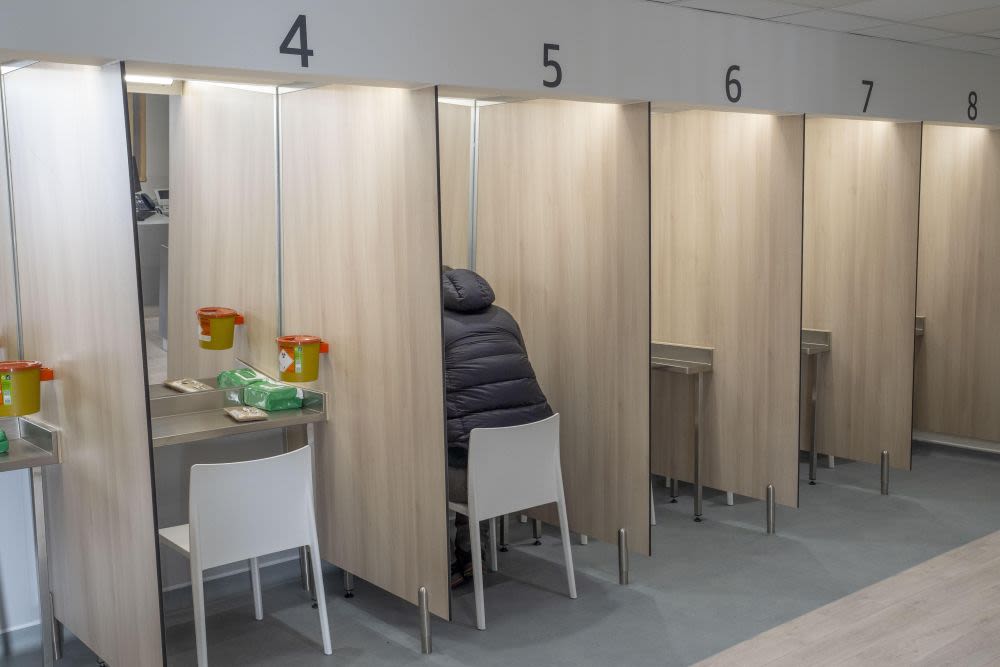
Glasgow, The Thistle injection bay areas
(Alamy)
12 min read4 hr
The Green Party’s success in English local elections has put fresh impetus behind efforts to follow Scotland in providing safer drug consumption facilities to addicts. Matilda Martin investigates
At the end of a short and unassuming driveway at 55 Hunter Street in Glasgow lies The Thistle. From the outside, the pebble-dash-style one-storey block looks like any other NHS healthcare centre. But what unfolds behind its doors is unique. In January 2025, the site became home to the first safer drug consumption facility (SDCF) in the United Kingdom. Here, individuals can inject their own drugs under clinical supervision, while at the same time accessing treatment and support.
Ultimately, campaigners and experts argue that such a move could be replicated in England at a local authority level, if arrangements were made with local police forces. While a change in the law to allow such facilities would be more straightforward for councils, it may not be entirely necessary, as Scotland has demonstrated.
Now well into its three-year pilot, and with frustration growing over the Westminster government’s refusal to change course, Green-run councils in England are looking to The Thistle to see if a similar approach could be replicated south of the border. The House has spoken to multiple Green-run councils, many of whose administrations were freshly formed in May 2026, about how they are exploring safer drug consumption facilities/rooms and other harm reduction spaces.
There is understandable nervousness among Greens pushing for the change. While Labour’s attack line in Gorton and Denton, which focused on the Greens’ position on drug legalisation, is seen as having been largely ineffective, there is awareness among those advocating for harm reduction spaces that the public will need to be on board for this to work. And formidable regulatory and legal hurdles remain.
The path to the opening of The Thistle was far from smooth and took almost a decade. The site was first proposed in 2016 after an HIV outbreak in Glasgow was detected among people who inject drugs.
The UK government had refused to waive the Misuse of Drugs Act 1971, under which those in possession of drugs attending the clinic would likely be criminalised. In Scotland, drug policy is not devolved, so the council’s hands were tied – until January 2025, when the then lord advocate for Scotland Dorothy Bain made a watershed decision, stating that it would not be in the public interest to prosecute users of the centre for possession.
Drug policy expert Professor Alex Stevens, who once sat on the UK Advisory Council on the Misuse of Drugs, argues that councils in England could replicate the move by working with local police to agree that it would not be in the public interest to prosecute the users or staff of a facility for drug possession.
He tells The House that “this would clear the way” for those agencies who want to run a SDCF to do so.
It’s being realistic about drugs and bringing them under control rather than just pretending we can just police our way out of the problem
These facilities are sometimes referred to as “overdose prevention centres”, a term Stevens claims is more accurate: “That’s what they’re intended to do. They’re not there because we want to facilitate drug consumption. They’re there because we want to reduce the deaths and health harms related to overdose.”
Niamh Eastwood, executive director of Release, the UK’s centre of expertise on drugs and drug laws, agrees: “If local police forces provided a memorandum of understanding to providers to allow people who are in possession of a controlled drug to access such centres, this would go a long way to reducing or eliminating the legal risk, as is the case with The Thistle in Glasgow.” The ideal approach for them, of course, would be a change in the law.
The Home Office maintains that the use or running of such a facility would likely engage “a range of offences” under the Misuse of Drugs Act, including “possession of a controlled drug, production of a controlled drug, permitting premises to be used for the production of a controlled drug, provisions of paraphernalia and supply of a controlled drug”.
Eastwood argues that the issue of supply is not unique to drug consumption rooms and is in fact something that many premises, including nightclubs, need to consider when customers bring drugs into their establishments. She also pushes back on the paraphernalia point, asserting that The Thistle only provides equipment that is lawfully exempted.
However, the issue of production is a more grey area, she says, stating that, hitherto, the preparation of heroin for injection for personal use has not been treated as a production offence under the current law – and such an expansion of the legal definition would be unlikely. She contends that this wasn’t a matter of concern for the lord advocate in relation to The Thistle, who limited the scope of prosecution policy to disregard the possession of controlled drugs for personal consumption offences only.
In England, the Councillors Harm Reduction Network, set up a year ago, is gaining momentum in the aftermath of the May 2026 local elections when the Green Party swept to victory in five councils and formed minority administrations in several more.

Leading the way is councillor Cara Lavan, who has been exploring how or whether Bristol city council could open an SDCF and other harm reduction spaces since she was first elected to the council in May 2024. Earlier that year, Bristol had become home to the UK’s first regular drug checking service, after it was licensed by the Home Office.
In July, the Green-led council made headlines after councillors voted through a motion declaring Bristol a “city of harm reduction”, encouraging a supportive rather than a punitive approach towards drug users.
The motion, which drew support from Labour and Liberal Democrat councillors, also pledged to advocate for permission and funding from the government to establish supervised drug consumption facilities in Bristol.
For Lavan, who put forward the motion, the issue is personal. Lavan lost her partner Jake Coe to drug overdose poisoning more than a decade ago.
“It’s being realistic about drugs and bringing them under control rather than just pretending we can just police our way out of the problem, which any police officer will tell you privately we can’t,” she tells The House.
Lavan is confident that the public can be won round when it comes to harm reduction measures, including SDCFs: “It’s a matter of educating the public on it because any time you educate the public, you see there’s a light-bulb moment. I’ve been in so many public meetings where I’ve talked about this issue, and you see the light bulb go.”
In Bristol, Lavan says council leader Tony Dyer and local MP Carla Denyer have written to the last few home secretaries to ask for permission to establish a centre. Lavan tells The House that permission has always been denied, with successive ministers saying there is not enough evidence of the success of these facilities.
Could Bristol in theory move forward with a centre without a change in the law if they struck up an agreement with local police?
“The issue is moving parts”, replies Lavan, pointing out that in Bristol they would need buy-in from the director of public health. But she admits that “in theory, we could do it without the Home Secretary’s permission”.
Lavan has been unable to persuade local police, however. “I know from my work in Bristol that both Avon and Somerset Police and Public Health are deferring to the Home Secretary for that effective letter of comfort, the same as they have in Scotland, that says we understand this is not in the public interest to prosecute, and we understand these are measures that will save lives.”
Policy expert Stevens says this is a decision local police could make on their own – it is “a question of political will, not legality”.
“Chief constables have operational independence from the Home Office. And it is the police and the Crown Prosecution Service who decide whether a prosecution is in the public interest. Going against the wishes of the Home Office is politically difficult, but not illegal.”
In London, Green councils are pooling ideas for how they could move the city closer towards a harm reduction approach, with a range of harm reduction options being looked at, including SDCFs.
It is in the capital that the problem seems most pressing. In October last year, the largest increase in the rate of drug-poisoning deaths was recorded in London, with 662 deaths recorded in 2024, compared with 500 deaths in 2023. The release date for the 2025 stats is yet to be announced by the Office for National Statistics.
For Zoë Garbett, the new Green mayor of Hackney, the issue is one she has long campaigned for. As a member of the London Assembly, she put forward plans last year for a drug consumption room in the capital.
Like The Thistle in Glasgow, the facility – this time a mobile one – would have been a three-year pilot scheme. While the plans were ultimately voted down, Garbett was far from deterred. The Greens’ manifesto for Hackney this year included a pledge to work with other cities, leading harm reduction efforts to lobby the government to allow local areas to “set up safe consumption rooms (overdose prevention centres like The Thistle in Glasgow)”.
Hackney is historically the locus of the Green Party’s drug policy, with the current approach being drawn up and agreed upon by those based in the area in 2019. Garbett herself was one of those involved.
Garbett tells The House that her cabinet lead for healthy communities and adult social care is currently speaking to the public health team about how this could be achieved. The council also held a pop-up event on 31 August with the London Harm Reduction Collective, showcasing what a drug consumption room would look like.
“It was to start that conversation,” Garbett explains, “because I hear a lot from communities as a councillor when I was in Dalston and as the mayor, people are really worried about people using drugs in public. They’re worried about them for the drug users’ safety, and they’re worried about it from their safety or the safety of their children. But most people want a public health approach.”
When she went door-knocking in an area of high drug use in Dalston, Garbett recalls, most people she spoke to said: “‘I just want these folks to be OK. I just want them to survive. I want them to get the support they need.’ And that is exactly what a drug consumption room would do.”
People will slag it. I know they will. People will criticise it, but the majority of people who are criticising it don’t understand it
Garbett says such a room would not only prevent overdose but also be a space in which users can access support from health professionals.
Hackney council is also setting up an independent advisory group to investigate what harm reduction spaces, including a SDCF, could look like in the area. The group will also look at how to advocate for change and engage other organisations.
Garbett tells The House that a meeting with the six Green-run councils in London in mid-September discussed approaches to harm reduction and their desire to explore progressing drug consumption rooms.
Elsewhere in London, other Green-run councils are interested in a range of harm reduction options, including the opening of an SDCF.
The House understands that in Lambeth, the council is looking at a range of options. An SDCF is one option, another for example would be a space with toilets and some support, which addicts could go to, but not necessarily consume in. However the plans are in early stages and it is not clear exactly what this would look like yet.
There is also an awareness within the council that whatever model is agreed upon will depend to an extent on what the feeling of the police is in Lambeth towards any option and strategy. The council is alive to the risk that a change in police policy could have an impact, which will need to be factored in.
While the council had hoped to make some progress in the coming months, The House understands that there has now been a pause to consider the impact of any harm reduction space (not specifically a SDCF) on those who might work in them, ensuring employees are not put in a compromised legal position, as well as collecting evidence to counter concerns over a potential ‘honeypot effect’.
The possibility of a harm reduction space operating below the radar, using informal agreements under which street outreach teams go to areas where drug users are found, has been raised. But this lack of formal recognition could make the policy more problematic.
The council has also carried out a needs assessment in the past few months, which will report on the number of crack users in the borough later this year.
In Lewisham, Green mayor Liam Shrivastava feels a harm reduction facility “would be really important and positive”.
As a former Labour councillor, why does Shrivastava think the government is unwilling to change its stance on this?
“It’s fear, the sort of political risk attached, worrying that the Tories are going to say that they’re crazy, letting people take drugs, or they’re pro-drugs, or they’re this, or they’re that. And that is obviously an attack that Labour is trying to use on us, and that Labour used,” Shrivastava says, referring to the Gorton and Denton attack line.
Ronnie Cowan, the former MP for Inverclyde who helped campaign for The Thistle for over a decade, tells The House that the fight for a harm reduction approach is far from over, despite the Glasgow centre opening its doors: “People will slag it. I know they will. People will criticise it, but the majority of people who are criticising it don’t understand it. My biggest disappointment is that some people who I think should understand it are still critical of it. So, it’s a battle.”
As countries in Europe, from Spain to the Netherlands, begin to open drug consumption rooms, the UK seems unmoving. While a policy change at government level seems unlikely, an increasing number of councils pushing for this in England could become a thorn in the Home Office’s side.